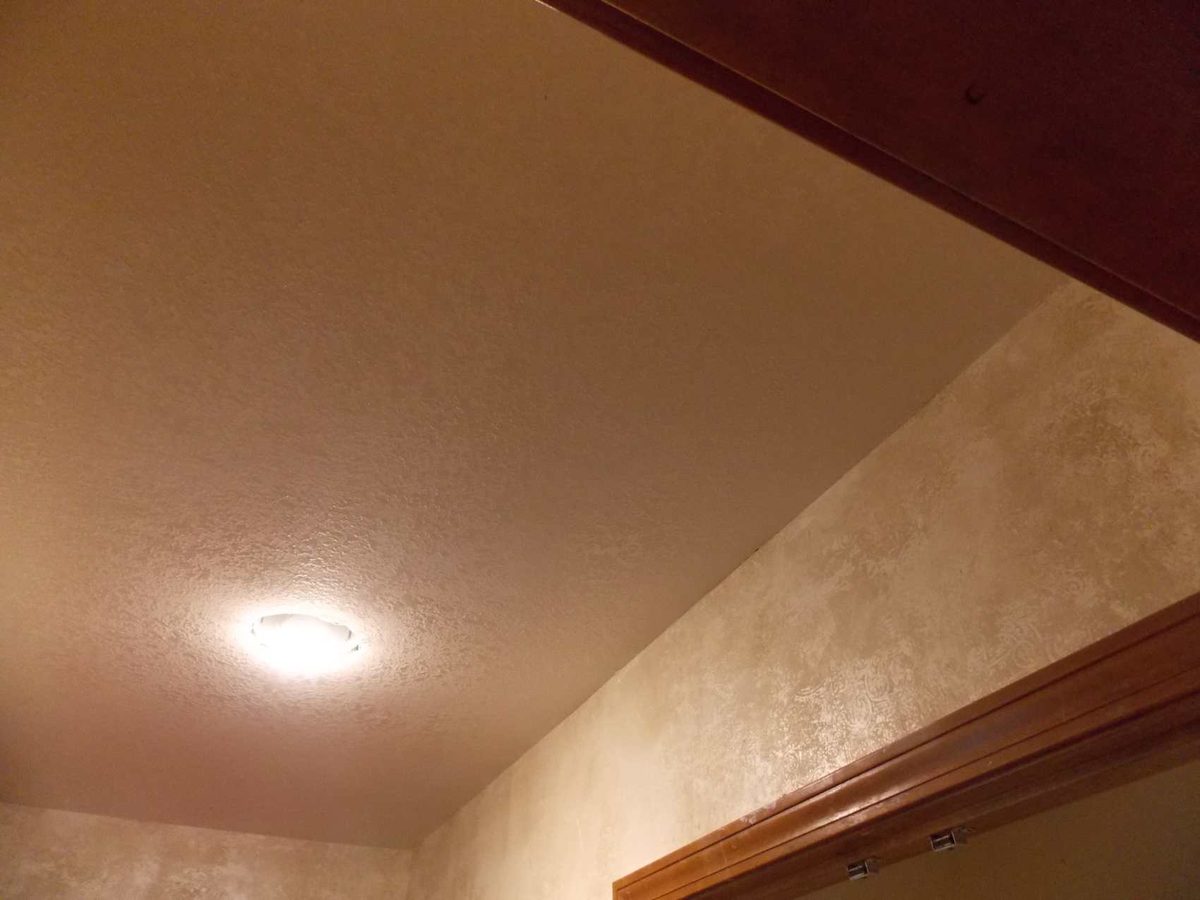
The three drywall textures you'll find in most Lee's Summit homes are orange peel, knockdown, and popcorn (plus the occasional smooth wall). Orange peel is a fine spatter that looks like the skin of an orange; knockdown is that same spatter flattened with a knife, and it dominates 1990s-and-newer subdivisions; popcorn is a heavy sprayed ceiling texture you'll see in older homes. When you patch a hole or crack, matching the existing texture — not just filling the damage — is the single thing that decides whether the repair disappears or stands out forever.
The Three Textures You'll Find in Lee's Summit Homes
Here's a quick reference for the textures we match every week across Lee's Summit and the Kansas City metro:
| Texture | What it looks like & where you'll see it |
|---|---|
| Orange peel | Fine, bumpy spatter — common on 1980s–2000s walls and some ceilings |
| Knockdown | Spatter flattened with a knife — the dominant wall & ceiling texture in '90s-and-newer subdivisions |
| Smooth / level finish | Flat, no texture — some newer customs, accent walls, and skim-coated older plaster |
| Popcorn / acoustic | Heavy sprayed ceiling texture — ceilings in homes built before the ~1990s |
How to Tell Which Texture You Have
You don't need to be an expert to identify your texture — just look closely:
- Use raking light. Shine a flashlight along the wall at a sharp angle. Round, even bumps are orange peel. Flattened peaks with little plateaus are knockdown. A flat surface with no shadow is smooth.
- Look up. A bumpy, cottage-cheese ceiling is popcorn. Walls are almost never popcorn.
- Take a close-up photo. Snap a picture an inch or two from the surface and zoom in — the pattern is obvious on screen, and it's exactly what we ask for when you send a quote request.
Why Texture Matching Is the Hard Part of a Drywall Repair
Cutting out damage and hanging new board is the easy 20% of the job. The skill is in the finish. Texture is sprayed at a specific droplet size and air pressure, knockdown has to be timed so it's flattened at the right moment, and the whole repair has to be feathered out so there's no ridge where new meets old. Then there's paint: even a perfect texture match can show if the surrounding paint has faded or has a different sheen. A specialist blends both the texture and the paint so the eye never catches the seam. That's the difference between a patch you forget about and one you notice every time the afternoon light hits the wall.
Matching Texture in Older vs. Newer Lee's Summit Homes
Lee's Summit is mostly 1990s-and-newer construction, so knockdown is by far the most common texture we match here — especially in the subdivisions that filled in through the 2000s. Older central Lee's Summit homes and the surrounding established neighborhoods are more likely to have orange peel, smooth plaster, or popcorn ceilings. Newer custom homes sometimes go fully smooth, which is actually one of the harder finishes to patch invisibly because there's no texture to hide the repair. We match all of them.
Can You Always Get an Invisible Match?
For the texture itself — yes, almost always. The honest caveat is paint. If a wall's paint has aged or you've lost the original color, a spot repair can be slightly visible even with a perfect texture match, so we'll often feather the new paint out to a corner or a natural break in the wall. On a ceiling, spot-matching old popcorn is possible but rarely looks as clean as simply removing the popcorn and refinishing the whole ceiling — which is why popcorn removal is one of our most-requested jobs. We'll always tell you upfront which approach will look best for your room.
Match It or Remove It?
If you love your texture, we match it. If you're tired of a dated popcorn ceiling or heavy wall texture, we can remove it and refinish smooth or in a clean modern knockdown. Either way, the work is handled by a drywall specialist, not a generalist — see texture matching for the full rundown, or check typical pricing in our drywall repair cost guide. Serving Lee's Summit and the Kansas City metro.